Why the urge to change everything tends to hit right before demolition, and why it usually is not a sign your plan is wrong
What one mid-project change actually sets in motion, from re-drawing to rescheduling every trade lined up behind it
How to tell a change worth making from a case of cold feet
Why the cost of a change depends less on what you want and more on when you ask for it
You can almost always make a change after your remodel has started. The question is rarely whether you can. It is what it will cost you, and that depends almost entirely on when you ask. A change made while the plans are still on paper is a conversation. The same change after the walls are framed or the tile is set can mean tearing out finished work, reordering materials that take weeks to arrive, and pushing back every trade scheduled behind it.
There is a moment that catches almost every homeowner off guard. The plans are signed. The selections are made. Demolition is a few days out. And somewhere in that quiet week, your brain turns on you. You start wondering if the island is in the right spot. Whether you should have added a window over the sink. Whether the tile you fell in love with three months ago is the tile you want to live with.
Here is what we tell our clients when that hits: it is normal. It happens to nearly everyone, and it does not mean you made the wrong call. It means the project stopped being a drawing and started being your house.
The trouble is that not every second-guess is created equal. Some changes are worth making. Some are just nerves. And the cost of getting that wrong, once the crew is on site, is measured in weeks and thousands of dollars. So before you call and ask us to move a wall, it is worth understanding what a change in the middle of a remodel sets in motion.
Why does anxiety spike right before demolition?
Is it normal to want to change things once the remodel gets real?
Yes. The urge to change something almost always shows up right as the project turns physical, when a line on a drawing becomes a framed wall you can stand inside. That shift makes every decision feel permanent and final, which is unsettling even when the plan is a good one. Wanting to adjust something is not evidence that you chose wrong. It usually just means the project got real.
The design phase is abstract. You are choosing from samples on a table, finishes on a screen, a floor plan you read like a map. It is easy to feel calm about decisions when they live on paper, because paper does not have a footprint you can walk through.
Then demolition happens, the framing goes up, and your house stops matching the picture in your head. The kitchen looks smaller framed than it felt in the rendering. The hallway you approved is suddenly a real hallway you are walking down. Your brain, faced with all of that becoming permanent, does the most human thing there is: it reaches for control by reopening decisions you already settled. (We have watched clients who were certain about a tile for two months start to waver the morning the installer shows up with the first box.)
Most of the time, that feeling passes on its own. The room that looked small framed feels right once the cabinets and counters are in. What you are reacting to is the shock of scale, not a flaw in the plan. So the first question to sit with is not what should I change. It is whether you are responding to a problem worth solving or to the simple fact that it is finally happening.
That distinction matters, because once the crew is on site, acting on the feeling is no longer a conversation. It sets things in motion.
What actually happens when you change something mid-project?
A change in the middle of a remodel is rarely just one change. Moving or adding something usually touches framing, plumbing, electrical, drywall, cabinetry, and finishes, and every trade scheduled behind that work has to be reordered. So a single request ripples outward into days of rescheduling and materials that take weeks to arrive, even when the change itself sounds small.
The reason a change feels bigger to your contractor than it does to you is that you are picturing the result, and we are picturing everything that has to move to get there.
Here is one we lived. We were partway through a kitchen remodel. Walls were framed, the cabinet layout was set, and the homeowners decided they wanted to add an ice maker. Reasonable request. Here is what that one appliance set off: we modified the framing to extend the space, ran new plumbing for a water supply and a drain line, added electrical to the new location, reworked and refinished the drywall, and reordered a smaller cabinet to make room. Even expedited, the new cabinet took more than three weeks to arrive. The change ran in the range of $5k to $6k on top of the appliance itself, and it moved the schedule.
None of that was waste. It was the cost of adding something after the walls were already talking to each other. And it points at the thing most homeowners never see coming: the price of a change has less to do with what you want and more to do with when you ask for it.
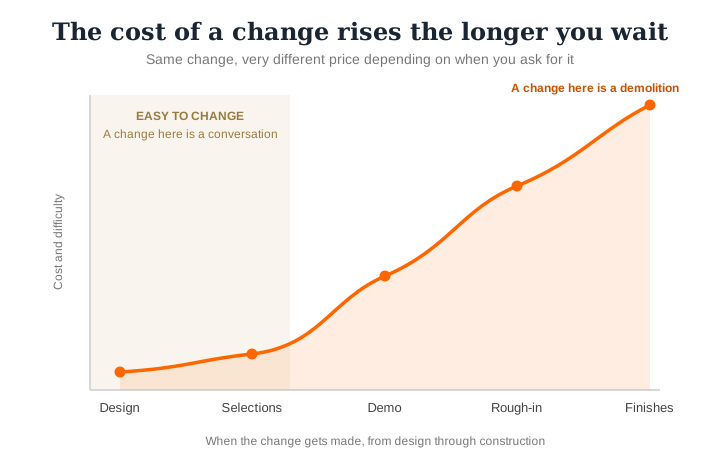
The same change costs almost nothing on the drawings and climbs steeply once the work is built.
It is worth sitting with that chart for a second, because it is the whole argument in one picture. The bottom is the life of a project, from the first design conversations on the left to the final finishes on the right. The line is what a change costs you, in time and in money, depending on when you ask for it. A wall moved on the drawings is a quick redraw. The same wall moved after it is framed and wired is a teardown. The change never got harder. The timing did.
How much does a change really cost in time and money?
It depends almost entirely on timing. The same change is inexpensive on paper and costly once it is built, because late changes mean tearing out finished work, reordering long lead time materials, and waiting for a crew that has already moved to another job. A change made early can cost almost nothing in time. The same change made late can stall a project for weeks or months.
The clearest way to see this is two projects sitting at opposite ends of the timing curve.
On one remodel, the homeowners decided partway through that they wanted us to paint more of the house than the rooms we were already remodeling. They asked about a week before painting was scheduled. Because we had that week, we planned it, priced the additional rooms, and folded the work into the existing schedule. The painting cost what extra painting costs, but the timing cost nothing. Had they waited until the painters had finished and moved on, we would have had to work that crew back in around another job, and that same addition would have tacked a week onto the project on top of the expense.
Now the other end. We built an attached ADU in Scottsdale. The plans were drawn and approved for a single entry door. Right before the exterior stucco went on, the homeowners decided they wanted a double door instead, custom iron. Good instinct, beautiful result, terrible timing. We had to stop the job cold. They travel often and the Scottsdale house is a second home, so finalizing the new door details and pricing took nearly three weeks of back and forth. Then the door itself took 8 to 10 weeks to manufacture and install. Add the framing to enlarge the opening, relocating the light switches and the exterior wall sconce that the wider opening displaced, and the upgrade to the door itself, and the change ran upward of $12k to $13k. The bigger cost was time. The project sat with no work happening for roughly three months.
This is not unique to us. One remodeler’s review of completed projects found that change orders added about 8% to the final cost on average, and that most of the priciest ones were discretionary, things the homeowner asked for after the work was underway (New Avenue Homes). Their own conclusion is the same one this whole page is built on: it is easier to make the change on paper than in the field.
When is a change actually worth making?
Some changes are worth making even mid-project: a safety issue, a mistake in the plan, or a meaningful change in how you will live in the space. A good design and build team will never talk you out of one of those. The changes worth pausing on are the discretionary ones, made out of nerves rather than need, where the cost in time and money outweighs what you gain.
We are not telling you to white-knuckle your way through a remodel and refuse to change anything. The opposite. The last thing we want is for you to stand in your finished house wishing you had said something. This is a safe space to speak up. If something is nagging at you, tell us, and we will walk through it together. The point of this section is not to talk you out of changes. It is to help you tell the difference between a change that earns its cost and one that is just the project getting real.
A change earns its cost when it fixes something. If a plan misses how your family moves through a kitchen, if an aging parent is moving in and the bathroom needs to work differently, if we got something wrong, those are worth making and we will make them. It will not hurt our feelings.
Where we ask you to slow down is the discretionary change, the one driven by second-guessing rather than a problem. And sometimes the smartest move is not refusing the change, it is changing how we confirm the decision in the first place. We learned that one the hard way. On a project where the homeowners had finalized a wood floor in the design phase, we ordered the full 3,000 square feet. When it arrived, they no longer liked the color across that much floor. We leaned on a long relationship with our supplier to exchange it, so it did not cost them money, but it cost the project a couple of weeks. So we changed our process. Now, before a floor selection is locked, we order a full box first so you can see how the shade varies across an entire run, not a single sample. The fix for a costly change is usually a better decision earlier, not a braver one later.
How do you avoid needing changes in the first place?
You move the decisions earlier. Most changes in the middle of the project happen because the design was never fully resolved before construction started. When the same team designs, prices, and builds the project, the conflicts and second-guesses surface on paper, where a change is a quick redraw instead of a demolition. The goal was never to lock you in. It was to settle every decision while it was still easy to change.
There are two common ways a remodel gets built, and the difference between them is mostly about when the hard decisions get made.
In the traditional path, one party designs the project, then you take those drawings out to builders for pricing, then a third party builds it. The industry calls it design-bid-build, but the plain version is that design and construction live in separate hands. Gaps and conflicts in the plan tend to surface once the building starts, because the people building it were not the people who drew it. That is fertile ground for change orders.
A design and build team puts all of it under one roof. We design your project knowing exactly how we are going to build it and what it will cost, so the questions that would otherwise ambush you in week six get asked and answered during design, on paper, where changing your mind costs a conversation. By the time we start construction, the decisions are already made, seen, and priced. (This is also why the design phase can feel slower than you expect. That is the work doing its job.)
If you want to understand how the design build model controls cost and surprises across a whole project, that is its own subject. We wrote about it here: design-build remodeling in Phoenix.
What this looks like when you work with us
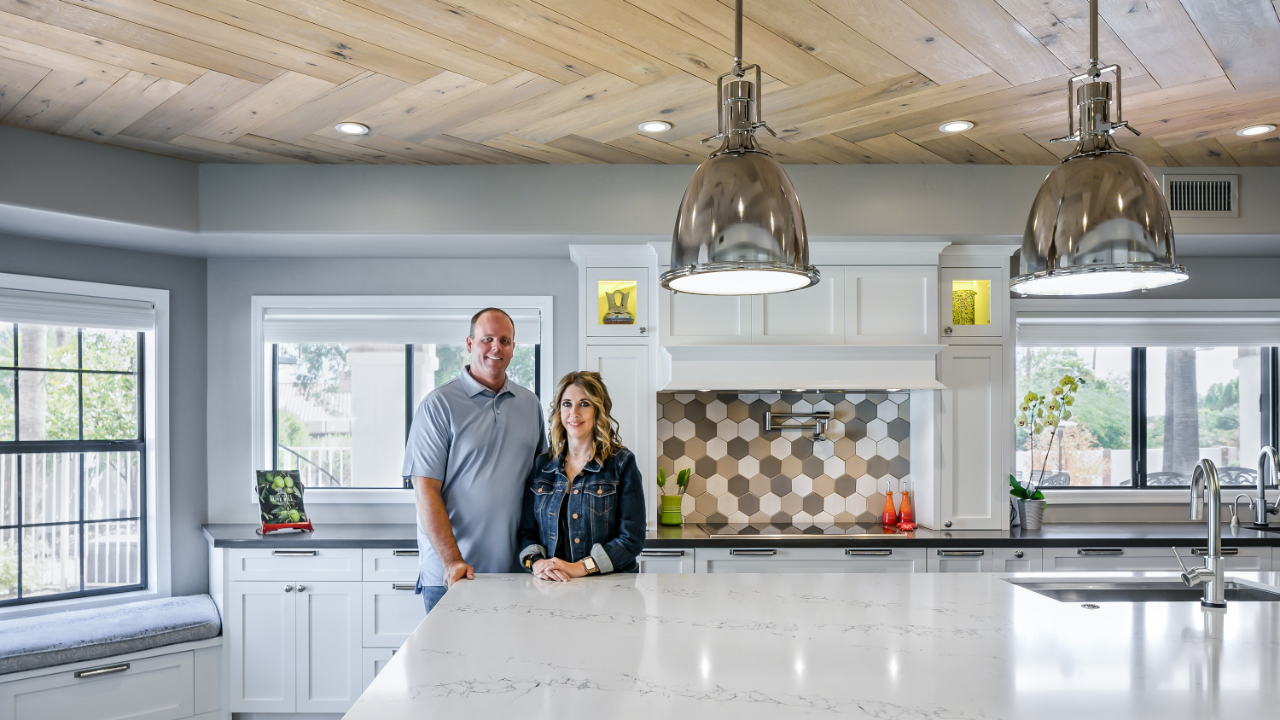
Scott and Lorrie Hochuli founded Hochuli Design & Remodeling Team in 2001. They design and build kitchens, bathrooms, whole home remodels, additions, and guest houses across the greater Phoenix area.
Our process is built to make the decisions before the demolition. We design and price your entire project together and finalize every selection before we start. You approve it, and we lock it into a fixed price contract in writing. Then we build it, with the costly surprises already handled on paper. The result is a project where you are living with decisions you saw coming, not reacting to ones you did not.
Everything on this page is why we run our projects the way we do. Three steps, in plain terms:
First, we design and price the whole thing together. Every selection, down to the floor and the fixtures, gets made and seen during design, while changing your mind is still just a conversation.
Second, you approve it and we put it in writing. Fixed price, fixed contract, everything agreed before a nail is driven. You know the number, and you know it is not going to move on you unless you choose to move it.
Third, we build it. Because the decisions are already settled, construction is about execution, not improvisation. The ice maker, the door, the floor color, all of that got handled back when it was still easy to handle.
We have been doing this in greater Phoenix since 2001, across hundreds of projects, and the single biggest favor we can do for a homeowner is to get the decisions made early, while they are still simple to make. You can read about exactly how we run a project here: our remodeling process.
Settle the decisions while they are still easy to settle
Wanting to change something once your remodel is underway does not make you indecisive. It makes you human. The calmest version of any change is the one you make before the crew shows up, which is exactly what a good design phase is for. No hard sell, no pressure. Just a clear look at what you want and what it takes to get there.
You can also read what our clients say on Google Reviews.
Common questions about making changes during a remodel
Can I make changes after my remodel has already started?
Almost always, yes. The real question is what it costs, and that depends on timing. A change while the plans are on paper is simple. The same change after the work is built can mean tearing out finished work and waiting on materials.
How much do change orders usually add to a remodel?
Industry reviews put the average around 8% of the final cost, with most of the priciest changes being discretionary ones the homeowner requested after construction started. Your number depends entirely on what you change and when.
Why does my contractor seem reluctant about a small change?
Because a change that sounds small to you often touches several trades and the whole schedule. We are not reluctant to do it. We just want you to see the full cost in time and money before you decide.
How do I avoid expensive changes altogether?
Make the decisions early. A design and build process is built to surface every question during design, on paper, before construction starts, so the changes happen when they are still easy to make.

 Scott Hochuli